KPMG surveyed more than 70 large companies across Central Asia and the Caucasus and compared their responses with a global sample of 2,500 technology executives. The report reveals a region that has markedly accelerated its technology adoption over the past year — artificial intelligence above all. In this article, we break down the report's key figures and what lies behind each of them.
The region no longer waits for a technology to be proven
A year ago, the mood was different: 78% of companies were concerned about the pace of technological change, and 80% acknowledged that senior management's caution was holding them back relative to competitors. The region viewed new technologies with apprehension and preferred to wait until the rules of the game became clearer.
Today, only a third of companies hold the wait-and-see position of “wait until the technology is proven” — less often than in the world at large — while nearly half of organizations already treat technology experimentation as a strategic norm rather than an exception to the rules.
Behind this change lies not a fashion for experimentation, but the fact that classic planning no longer works at the pace it once did, and the region is using pilots to find a workable replacement for that approach.
This is especially evident in artificial intelligence, where the shift has been even sharper than across other technologies. CAC (Central Asia and the Caucasus) is entering this era not as a late starter. In the share of companies that have already moved AI into production with a measurable effect, the region is ahead of the world. Yet it is precisely this lead that raises the report's next question: if the speed is already there, what determines the outcome next? In answer, the report's authors point not to launch speed but to the ability to turn individual successes into a sustainable system with clear accountability and mature governance.
How the region accelerates without losing control
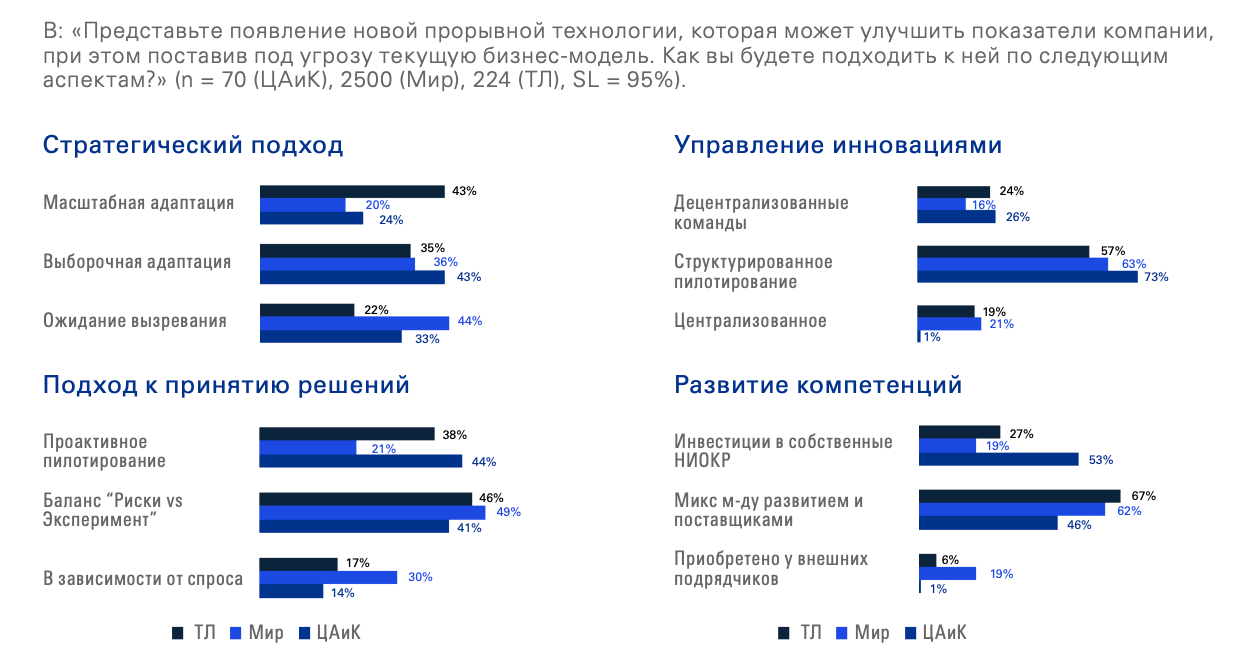
Since speed in itself no longer provides an advantage, the question becomes how exactly the region sustains it without sliding into chaos. The answer lies in its management model: the region moves through a portfolio approach, combining rapid pilots, strict risk boundaries, and a bet on in-house capabilities rather than one-off purchases of off-the-shelf solutions.
This model is noticeably more democratic than the global one. Instead of a cumbersome center that must approve every decision, companies run a portfolio of pilots with clear constraints, success criteria, and decisions about what to scale and when.
But behind this flexibility lies a paradox at the level of attitudes. 75% of CAC companies place themselves in the top tiers of resilience to change, almost on par with the global figure of 80%, yet the region's investment style is markedly more reactive: about 25% of companies are guided by trends and external signals, against only 3% worldwide.
However, this reactivity does not equal impulsiveness, and that is the key nuance. Where the cost of error is high, the region maintains discipline: 58% of companies choose to follow zero-trust principles even at the cost of slowing innovation, against 16% worldwide, and acceleration remains acceptable only within strict security boundaries — particularly in finance, government services, and infrastructure.
As a result, strategy in this logic ceases to be a one-off declaration and becomes continuous fine-tuning, especially where the rules are set by the institutional and regulatory environment. It is this fine-tuning that explains why the region selects technologies not by hype but by what they promise the business — which leads to the next question: how exactly CAC companies justify their technology investments.
Why the region frames technology in terms of growth rather than payback
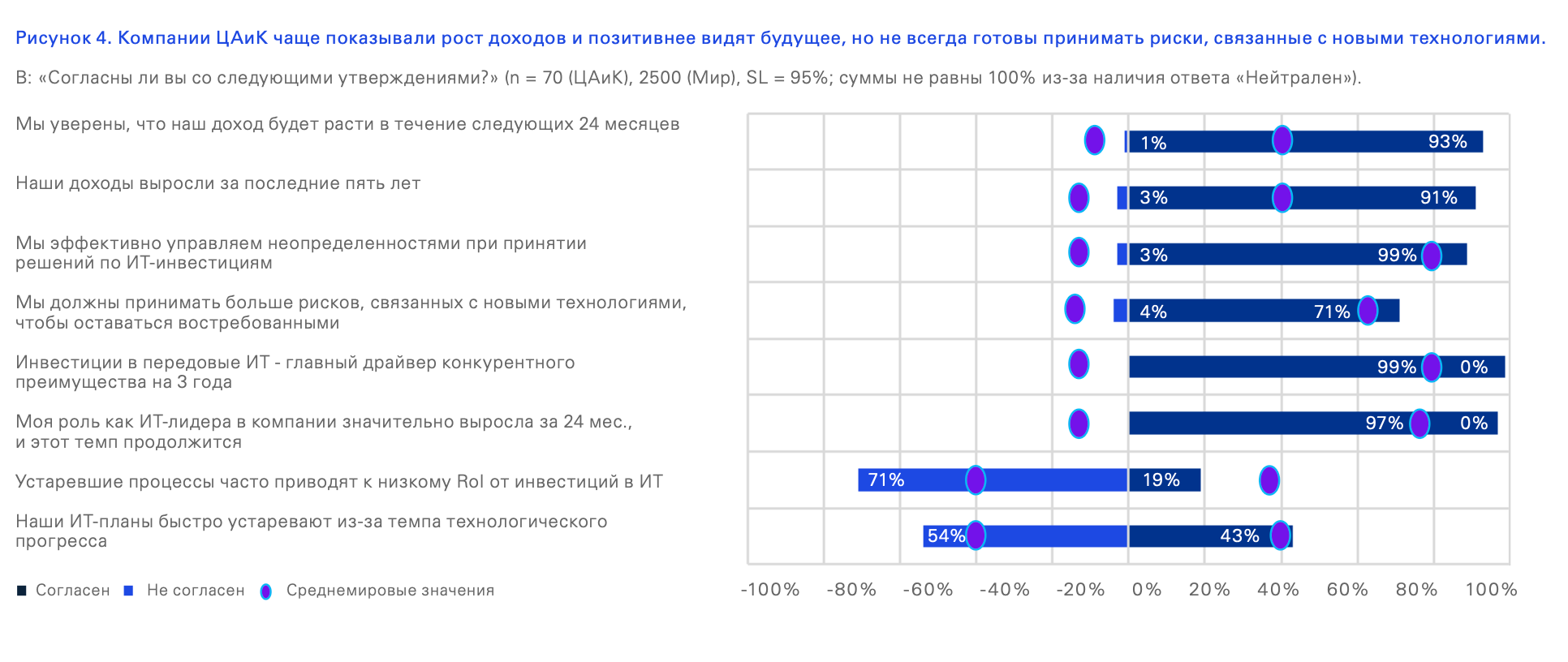
The rest of the world increasingly has to justify technology in terms of difficult payback and integration, whereas CAC speaks the language of growth. Among the benefits they expect, companies in the region cite revenue growth (43% against 30%) and faster time to market (39% against 28%) noticeably more often than their global peers.
99% of respondents consider investment in advanced technologies the main source of competitive advantage over the next three years, and three forces underpin this confidence at once: belief in technology as a source of advantage, management confidence in navigating uncertainty, and general economic optimism.
But the more confidently the region speaks of growth, the more important the question of what that confidence rests on. The line between real progress and the appearance of it runs precisely along measurability: confidence without regular validation by results easily becomes an illusion of effectiveness, whereas measurability itself becomes the advantage that is hardest to copy, because it is built not by purchasing technology but by management discipline. The same logic can be traced in how the region allocates its technology budgets.
What the region spends its technology budgets on
In terms of annual investment, CAC differs markedly from the global picture: almost three quarters of the region's companies fall within the range of USD 100–500 million a year, whereas worldwide these same ranges cover only 42% of companies, and a quarter globally remain below the USD 50 million mark.
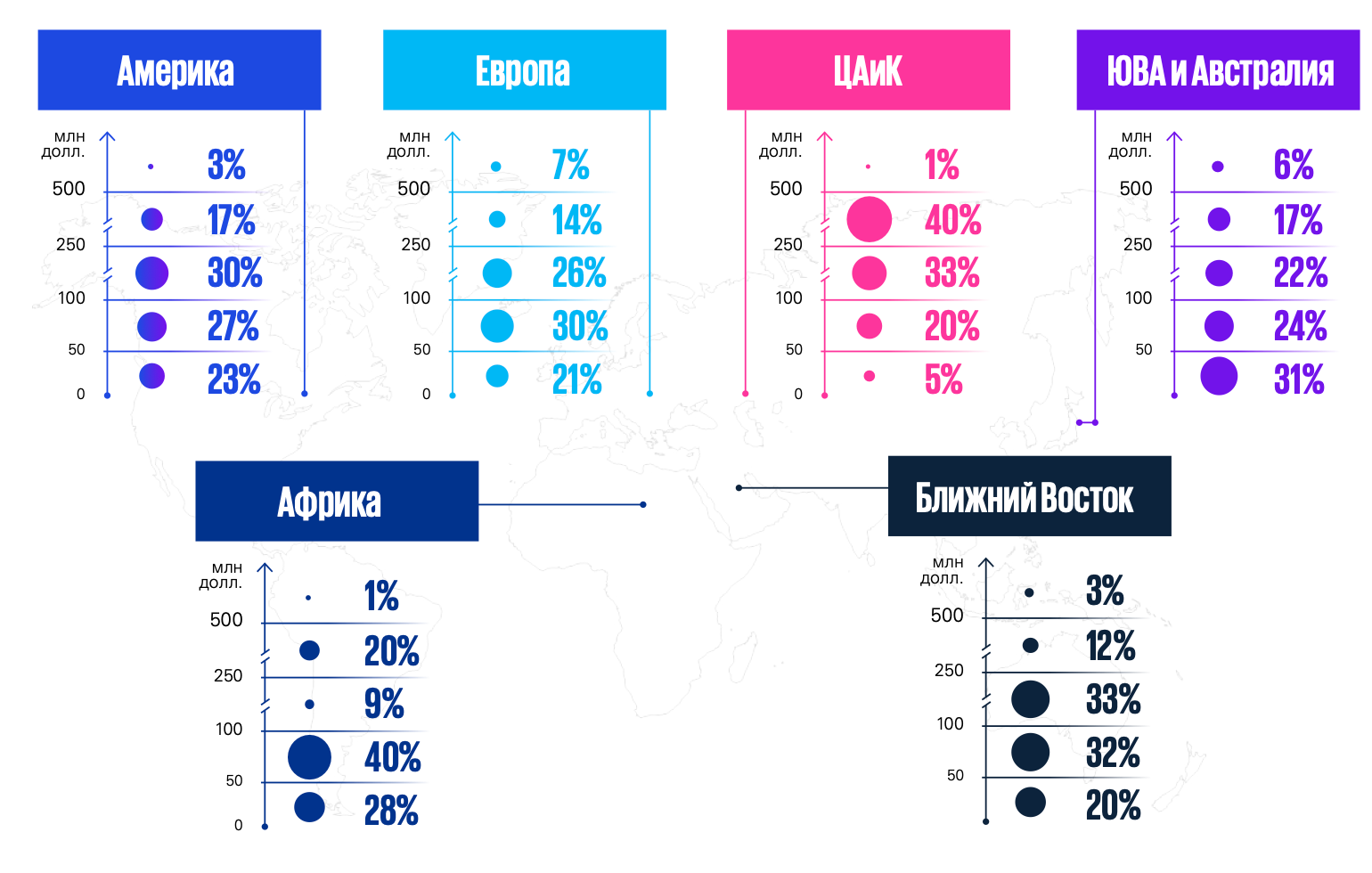
This scale is explained by the fact that for many companies in the region, digital transformation is still in the foundation-building phase, and at this stage even mid-scale investment delivers a rapid effect by eliminating downtime, manual operations, and process fragmentation.
The authors identify cybersecurity as the leading priority: 63% of companies have significantly increased their budgets, against 41% worldwide, with particularly notable growth in Georgia and Uzbekistan. Next come data and analytics (82% against 73%) and AI automation (81% against 76%), while digital twins stand out separately — in Uzbekistan, 100% of companies plan to increase their budget for this area, against 87% across the region and 72% worldwide, which is explained by an economic structure built around capital-intensive industries such as energy and mining.
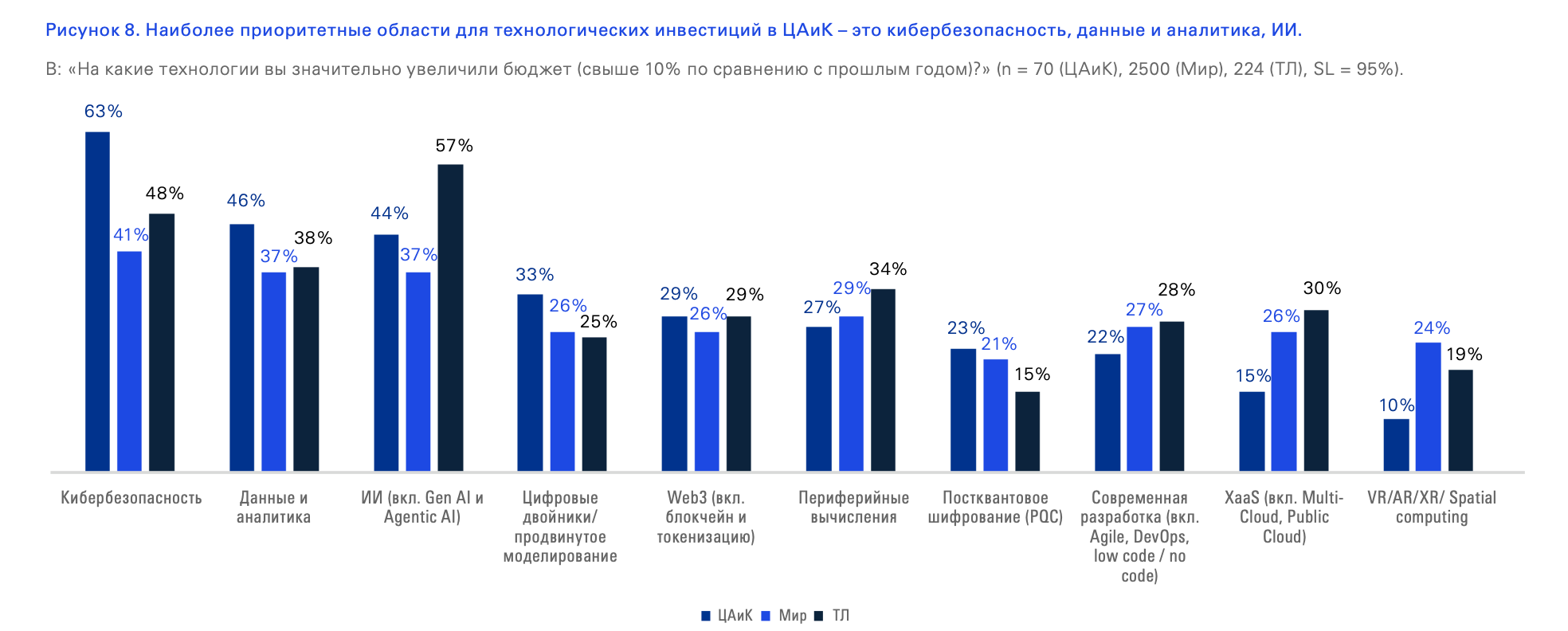
At the same time, spending on maintaining existing systems remains below global levels (around 21% of the IT budget against 34% globally), which means the region is investing in growth faster than in protecting what it has already built. The same imbalance between ambition and foundations is visible in how companies assess their own technological maturity.
Companies rate themselves higher than practice shows
The region rates its data management and cybersecurity above the global level — 93% and 89% against 85% and 86% — and IT service management is ahead here too: 92% against 85%.
But the higher the self-assessment, the more important it is to test it against practice, and here a potential trap hides behind the figures. 94% of the region's executives do not treat cybersecurity as a strategic priority as early as the new IT project stage, whereas worldwide 72% of companies report early security involvement. A high self-assessment of maturity here may indicate not built-in security, but compliance with baseline requirements that is mistaken for the maximum.
Tellingly, on complex topics the region remains far more cautious in its assessments. For example, only 3% of companies claim full maturity in post-quantum cryptography, against 9% worldwide.
The real gap appears where individual successes are supposed to turn into a system — namely, in IT portfolio and vendor management. This is what can be called the region's “glass ceiling”: companies know how to launch pilots but are worse at turning them into a corporate standard, and only 3% of companies have fully scaled modern development practices, against 13% worldwide.
The same gap between readiness to launch and the ability to sustain scale is visible in how the region builds its IT teams.
The region is betting on digital labor
The structure of IT teams today differs little from the global picture. About half of technology capacity comes from in-house staff, a third is handled by digital labor such as bots, RPA, and AI agents, and a fifth relies on external contractors.
But the trajectory this structure is moving along is already different. By 2028, the region expects the share of digital workers to rise to 40% and the share of contractors to fall to 14%, whereas worldwide the share of external resources remains stable at over 20% — there, outsourcing itself is not being cut back; roles within it are merely being redistributed.
Behind this shift lies an economics of scarcity: the growth of initiatives in data, cybersecurity, and AI outpaces the labor market's ability to supply the required skills, and digital labor is becoming the only scalable way to increase productivity without a proportional increase in headcount.
At the same time, centralization of IT functions remains low — only 14% of companies fully centralize architectural principles, against 37% worldwide — and the region more often chooses a model of “common principles, different execution speeds” over a rigid central platform.
This same choice of speed at the expense of a unified governance system is most pronounced in AI — the topic that everything ultimately comes down to.
AI is being deployed faster than companies learn to govern it
Here the region shows the sharpest contrast in the entire report: 53% of companies have already moved AI into production with a measurable return, whereas worldwide only 24% have done so. That said, the gap will narrow within a year, as the rest of the world is catching up fast.
But behind this impressive adoption figure lies the same gap as in the report's other sections: only 34% of companies have an enterprise AI strategy, whereas worldwide 76% do, and only 25% have established cross-functional AI governance, against 69% globally. At the same time, only 21% report difficulty demonstrating the value of AI, against 55% worldwide. The region readily proves the effect of individual use cases but is worse at embedding it as a system. In addition, 99% of companies consider geopolitical risks critical when selecting open AI models, against 83% worldwide — for the region, choosing an AI model has become not only a technical decision but a geopolitical one.
What to do about it
KPMG sets out six recommendations, and all of them are essentially about the same thing: how to sustain speed without breaking the system around it.
Strike a balance between innovation and foundations. Only 6–8% of transformation leaders cut investment because of technical debt or expensive projects, whereas in CAC 19% do so — even among large companies.
Ensure speed through clear boundaries rather than bureaucracy. 34% of technology leaders fully centralize the formalization of architectural principles, against 14% in the region — pilots and decentralization have already delivered speed; what is needed now is the discipline to sustain it.
Review technology development plans regularly. 43% of CAC companies acknowledge that their plans become outdated faster than they can be implemented, which means strategy must operate as a loop of regular portfolio reassembly, with selection criteria and the authority to stop a project that has not proven its effect.
Approach AI adoption systematically rather than “case by case.” 89% of technology leaders have a clear AI strategy, against only 34% of companies in the region.
Manage talent centrally. 55% of leaders handle technology workforce matters centrally, against only 33% of companies in the region — and up to 40% of roles in CAC will shift to digital labor within three years.
Engage actively with partners. 85% of high-performing companies interact regularly with external partners; in CAC only 51% do, while 24% rely exclusively on in-house resources, against 4% among the leaders.
If all the recommendations are distilled into a single thought, the result is exactly the gap that the report calls the main risk of the year: AI is scaling faster than companies can build governance around it, and models are already running in production while a unified system of accountability, data control, and value metrics is not yet in place.
At Gorgona AI, we help companies adopt generative AI and AI agents securely — from strategy and architecture design to the launch of enterprise solutions. If you want to harness the potential of AI without compromising on security and manageability, get in touch with us.