The artificial intelligence market in Uzbekistan is developing at a rapid pace, with dozens of companies, projects, and initiatives operating across fourteen segments. The government has adopted a strategy running through 2030 and has already invested tens of millions of dollars in GPU infrastructure. The startup ecosystem has grown by an order of magnitude over the past five years, surpassing $3.9 billion in value. StartupBlink named Uzbekistan Startup Country of the Year and recorded ecosystem growth of 227% — the highest figure among all countries in the index.
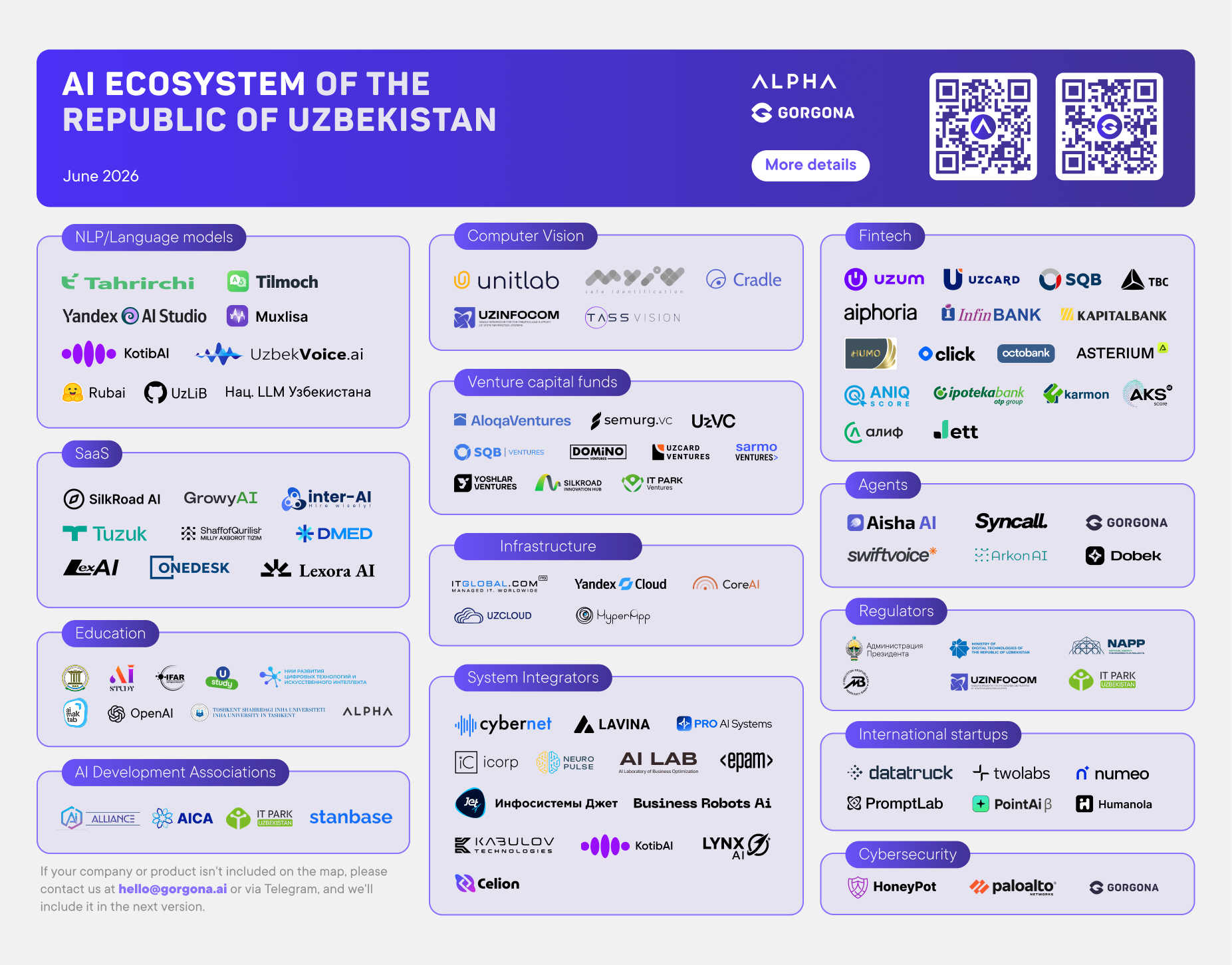
This is precisely why this map was created: as an attempt to capture market structure at the moment it is still taking shape. Gorgona AI, together with the ALPHA team, collected data on ecosystem participants, verified it against open sources, and organized it to reveal not merely a list of companies, but the underlying market logic — who is building infrastructure, who is creating products, who is responsible for security, and where growth potential exists.
The research reflects conditions as of June 2026, but the Uzbek AI market is growing faster than accounts of it can keep pace. We plan to update the map annually to track how the ecosystem evolves.
If your company or product does not appear on the map, please contact us at hello@gorgona.ai or via Telegram, and we will incorporate it in the next edition.
What the Map Covers
To reflect overall market structure rather than individual companies in isolation, we have grouped participants by key areas of AI development:
- Language solutions and NLP
- Computer vision
- AI agents
- AI assistants and business chatbots
- Fintech and AI-based credit scoring
- Vertical industry applications (LegalTech, TravelTech, HRTech, AgriTech, CRM)
- Cybersecurity
- Integration, deployment, and AI consulting
- Education, workforce development, and acceleration
- Investors and funds
- AI development associations and industry bodies
- International startups with Uzbek founders
- Government regulators
- Infrastructure platforms
The map features more than 100 participants in total. Our methodology relied on open sources and cross-verification — only players with confirmed indicators of active market presence were included.
Key Findings
The state is one of the primary drivers of AI development in the country. In 2024, Uzbekistan adopted the Artificial Intelligence Technology Development Strategy through 2030, establishing AI as a priority area within the digital economy. More than 100 AI projects are currently underway in the country, a significant share of which are tied to government initiatives and the digital transformation of key industries.
The financial sector is currently setting the pace for the economy's digital transformation. In 2025, the number of digital banking users reached 82.4 million, banking sector assets grew by 20%, and the share of cashless payments increased to 43% of all transactions. This trajectory creates natural demand for AI solutions in risk assessment, fraud prevention, service automation, and personalized financial offerings.
Language technologies form the foundation of the entire ecosystem. Unlike English-language markets, scaling AI products domestically depends directly on the quality of Uzbek-language processing. Despite rapid progress in recent years, Uzbek remains a low-resource language with a limited volume of digital training data. The largest open Uzbek speech datasets contain hundreds of hours of audio, while English-language datasets offer tens of thousands of hours. Against this backdrop, a dedicated cluster of companies and research projects is actively developing in the areas of speech recognition, speech synthesis, voice agents, and language models. The development of Uzbek-language datasets, LLMs, and speech technologies is foundational to scaling AI solutions more broadly.
The startup ecosystem is experiencing a notable surge. According to the Global Startup Ecosystem Index 2026 from StartupBlink, Uzbekistan was recognized as the world's fastest-growing startup ecosystem. Over five years it has grown thirteenfold, surpassing $3.9 billion in value. Internationally oriented players are emerging: Uzbek startups are already operating in the US market and gaining admission to leading global accelerator programs. The support infrastructure is being built by IT Park Uzbekistan, venture funds — both corporate and independent — and innovation hubs operating at the intersection of acceleration and international capital attraction.
Education and workforce development are solidifying into a distinct sector. The government has launched a program to train nearly five million AI specialists by 2030; universities are opening research laboratories; private educational platforms and corporate training programs are emerging. Nevertheless, the talent shortage remains one of the market's primary structural constraints — the gap between demand for AI competencies and their actual supply will persist for several more years.
Uzbekistan's computing infrastructure is developing actively, but a gap between stated ambitions and actual capacity remains. Despite new data center and cloud infrastructure projects, the country currently operates only approximately six data centers, which limits local data storage and processing capabilities. At the same time, demand for computing resources is growing rapidly alongside the digitalization of government services, fintech development, and AI adoption — while the pace of commissioning new computing clusters and the associated energy-intensive infrastructure remains insufficient.
Cybersecurity remains an underdeveloped area against a backdrop of rapid digitalization. The largest share of identified cyber threats falls on the ICT sector (51.4%), followed by the public sector (24.2%) and financial technologies (13.6%). As artificial intelligence adoption deepens, the risk of data breaches, algorithmic manipulation, and automated decision-making errors increases — making cybersecurity one of the most vulnerable elements of the digital transformation agenda.
Market Context
Over the past several years, Uzbekistan has transitioned from an observer of the global AI race to one of Central Asia's most active participants in digital transformation. In 2025, the country climbed eight positions in the Government AI Readiness Index to rank 62nd globally, confirming its status as the regional leader in government readiness for AI adoption.
AI development is occurring against a backdrop of sustained digital economy growth. The digital economy's contribution to GDP has reached 5.5–6.2%, according to UNDP data; e-commerce has grown more than 2.5-fold in recent years; and total direct investment in AI and IT development has approached $2 billion. As processes digitalize, data volumes grow — and with them, demand for automation, analytics, and personalization tools.
Demand for artificial intelligence technologies is already forming faster than the market can supply ready-made solutions. According to the Microsoft AI Economy Institute, the adoption rate of generative AI in Uzbekistan rose from 5.7% in the second half of 2025 to 7.2% in Q1 2026. Notably, 64% of working professionals already use AI tools at least partially, while another 20% plan to begin doing so in the near term.
This growth in demand naturally calls for a systemic response from the state. AI development is embedded in several strategic documents, including the Digital Uzbekistan — 2030 program and the AI Technology Development Strategy through 2030. Under the strategy, the volume of AI-based software products and services is targeted to reach $1.5 billion by 2030. To that end, the government is investing in the research and technology base: plans include establishing an AI and Digital Economy Development Center, launching ten specialized laboratories, and allocating $50 million to support the sector.
Entrepreneurial activity is simultaneously accelerating. As of the end of 2025, Uzbekistan ranks as the world's second-fastest-growing startup ecosystem and the leader in Central Asia by growth rate. The cumulative ecosystem value over 2020–2025 reached $3.9 billion; IT services exports grew 4.5-fold, approaching $1 billion. In 2025, 92% of investment attracted went to early-stage companies, with approximately $293 million of the $329 million total coming from foreign capital.
However, no unified estimate of the AI market specifically yet exists — which is itself an indicator of the market's formative stage.
The ecosystem, in short, has not yet caught up with its own growth. A talent deficit, limited access to computing capacity, a shortage of local datasets, and a still-developing regulatory environment constrain project scaling. This combination of rising demand and forming supply represents both a challenge for market participants and an open window for new products, investment, and technology initiatives.
Map Highlights
Fintech was the first sector to adopt AI at meaningful scale. Banks and payment services are deploying it for credit scoring, fraud detection, personalization, and customer service automation. According to KPMG's 2025 assessment, the AI maturity level among Uzbek banks remains moderate, but the market is already transitioning from experimentation to practical application in areas where impact is quickly measurable through risk reduction and lower operating costs.
Specific examples illustrate how varied the paths to adoption have become. Uzum — the country's first technology unicorn — embeds AI into personalization and operational processes. Aiphoria, in partnership with TBC, launched a voice AI platform through which 40% of call center calls are now handled by AI agents. TBC is also developing the Lola AI assistant, built on proprietary Uzbek-language LLMs and TBC Uzbekistan's speech technologies. SQB is advancing its own initiatives in analytics and customer service.
National payment systems UZCARD and HUMO are also moving toward AI. For example, UZCARD, in partnership with startup zyple.ai, launched the oneziyo.ai platform — a centralized AI layer for the financial market covering scoring, fraud prevention, stress testing, and transaction monitoring.
Among payment organizations, Click stands out. The app already features a virtual assistant named Cleo, while within the company, an AI infrastructure is being built — including AI agents that each department can adapt to its own workflows.
Many solutions emerging from the financial sector converge on the same challenge: natural language processing. Voice AI agents, chat banking, support automation, and digital assistants all require high-quality understanding of Uzbek speech and text.
Government and private initiatives are developing in parallel here. At the government level, a national Uzbek-language LLM is being developed; the open benchmark and dataset UzLiB enables quality assessment of language models; and a voice assistant called Muxlisa, developed by UZINFOCOM, is already in operation.
Yandex Uzbekistan has integrated Uzbek-language support into its Alice assistant via SpeechKit and launched a bilingual Uzbek-Russian mode.
On the business side, KOTIB AI — which began as a straightforward transcription service — has evolved into a broad business automation platform. The Tahcrichi platform addresses Uzbek-language text editing, while its internal Tilmoch service handles translation across Turkic languages. The RubaiSTT project by Uzbek researcher Sardor Islomov offers one of the most prominent open-source Uzbek speech recognition models, trained on 475 hours of audio.
Beyond fintech and the language stack, the map highlights several areas of specialized SaaS solutions. In LegalTech, Tuzuk AI and Lex AI are already operating, automating work with regulatory frameworks and legal processes.
Against this backdrop, a broader wave of startups building AI products across diverse verticals is also clearly visible. More than 100 AI projects are currently underway in Uzbekistan, and their number is expected to double by the end of 2027. In the legal niche, Tuzuk AI and Lex AI are joined by LexoraAI — a startup that analyzes Uzbek legislation and helps businesses navigate the regulatory environment. In HRTech, startups Growy AI and OneDesk are automating recruitment, candidate evaluation, and personnel management and development.
A niche of AI agent developers for specific business processes is also forming. Aisha AI and Arkon AI develop AI agents for automating customer interactions, HR, and sales — including for the hospitality industry. Dobek AI addresses accounting and tax compliance with 1C integration, automating report generation, VAT oversight, and bank statement processing. Gorgona AI operates on an on-premise model and targets businesses working with sensitive data — the company's platform is deployed locally within the client's own infrastructure, enabling the creation of secure AI agents without the risk of personal or confidential data leaving the company's perimeter.
The map separately highlights international startups founded by individuals of Uzbek origin — companies building products for global markets while remaining part of Uzbekistan's technology story. Twolabs AI became the first Uzbek startup accepted into Y Combinator; the company develops datasets for humanoid robots designed to care for elderly individuals. Unitlab AI is advancing a platform for data annotation in computer vision and machine learning tasks. Datatruck and Numeo AI operate in the US market with AI solutions for freight transport and logistics.
Computer vision is represented by several specialized players. TASS Vision and Cradle Vision develop AI-powered video analytics systems; TAD Industries focuses on facial recognition for security and time-tracking applications.
The map reflects a growing segment of system integrators that do not develop their own models but instead help businesses embed AI into day-to-day operations. They build chatbots, RAG systems [note: Retrieval-Augmented Generation — an AI architecture that combines language models with external knowledge retrieval], and AI agents; automate internal processes; and train teams on new tools. Major players in this segment include Cybernet AI, EPAM Uzbekistan, and Jet Infosystems Uzbekistan.
The state appears on the map in two distinct roles: as regulator and as the largest customer.
Strategic direction is set by the Presidential Administration, which establishes digital transformation priorities at the highest level. The Ministry of Digital Technologies serves as the primary regulator of the digital environment and the operator of government AI initiatives; the Agency for Technical Regulation is responsible for standards and certification; the Ministry of Justice oversees the legal framework for digital services.
The Central Bank and the National Agency for Perspective Projects, as key fintech regulators, set the rules of engagement for banks, payment systems, and e-commerce companies deploying AI.
UZINFOCOM serves as the government operator of digital infrastructure and is implementing several flagship projects, including MyID — a biometric identification system for government services — and DMED, a unified digital medical platform that incorporates an AI module for analyzing physician-patient dialogue and auto-filling examination records.
Education and AI workforce development warrant separate mention. In November 2025, the President of Uzbekistan launched the "Five Million AI Leaders" program in partnership with the UAE: by 2030, the initiative plans to train nearly five million people — schoolchildren, students, educators, and civil servants — in foundational AI tool skills and prompt engineering. TUIT [note: Tashkent University of Information Technologies] serves as a key implementer of the program at the higher education level.
An institutional foundation for deeper training is forming in parallel. In October 2025, Uzbekistan launched a partnership with OpenAI to integrate AI into the education system: ChatGPT Edu is being rolled out across educational institutions; AI courses are being developed for students and faculty; and a dedicated stream supports Uzbek AI startups through tool access and acceleration programs.
UZINFOCOM is developing UStudy — a platform for training students, professionals, and entrepreneurs in modern AI tools. Among private initiatives, the ALPHA educational center provides corporate training in AI tool adoption. AI Maktab — a project of the OSNOVA learning platform, supported by the Ministry of Education and New Uzbekistan University — targets schoolchildren, helping them develop digital literacy and foundational AI skills.
University-based research capacity is also taking shape: the Research Institute for Digital Technologies and Artificial Intelligence (AIRI), the Artificial Intelligence & Information Technology Laboratory (IFAR), the Laboratory of AI at TIIAME NRU, and the INHA AI Research Hub are conducting applied AI research and developing talent for the market.
The infrastructure layer on the map is represented by platforms providing the computing base for AI projects. CoreAI offers enterprise-grade GPU cloud services with local data hosting in Uzbekistan, running on NVIDIA H200, H100, A100, and other hardware. UzCloud provides a broad range of cloud services for business and government clients. Yandex Cloud gives local developers and companies access to global cloud infrastructure and machine learning tools.
The government is also building its own computing capacity. A $24 million GPU cluster has already been established, with plans to procure an additional $45 million worth of equipment by year-end. In 2025, the creation of a data center cluster in Karakalpakstan was announced, along with government subsidies for investors: digital infrastructure facilities valued at more than $100 million will receive electricity at a rate of five cents per kilowatt-hour.
Beyond individual companies and products, the map highlights associations that are shaping the sector's development environment. Alliance Uzbekistan unites market participants at the national level; AICA (the AI Association of Central Asia) operates more broadly, spanning Uzbekistan, Kazakhstan, Kyrgyzstan, and Tajikistan. IT Park Uzbekistan remains the primary entry point for startups, offering a preferential tax regime, acceleration programs, and a growth-enabling infrastructure.
Venture infrastructure is also actively expanding. The map features both corporate funds — AloqaVentures, SQB Ventures, and UZCARD VC, each affiliated with major telecom and financial sector players — and independent ones: DOMiNO Uzbekistan Fund and the Uzbek fund of funds UzVC, which is focused on supporting the venture ecosystem as a whole. Silkroad Innovation Hub combines accelerator and investment platform functions, operating at the intersection of startup support and international capital attraction.
On the map, cybersecurity is one of the least-populated segments. The players represented include Palo Alto Networks — which has a strategic agreement with Uzbekistan covering AI integration into national infrastructure — and local firm Honeypot, which focuses on web application security.
But as the number of AI deployments grows, this segment's landscape will change. Conventional threats represent one layer of risk. AI introduces another: data that leaves the company's perimeter with every query sent to a cloud model; agents with excessive access to corporate systems; opaque decision-making processes that are difficult to audit. All of this is bringing the market face to face with a new class of risks that requires a dedicated approach.
At Gorgona AI, this is precisely where we operate: our platform is deployed locally within the client's infrastructure, enabling the creation of AI agents without transmitting data outside the company's perimeter. This is one of the reasons we undertook this research — the market is evolving rapidly, and understanding where it stands today matters to us as much as it does to anyone.
About the Authors
Gorgona AI is a company specializing in the development and deployment of AI agents for business. It operates on an end-to-end model: supplying hardware, providing an agent development platform, and helping clients gain deep understanding of their business processes so that deployment delivers measurable outcomes — not polished demos. The focus is on secure implementation: the platform is deployed locally within the client's infrastructure, with no data transmitted to external servers.
For AI agent deployment inquiries: hello@gorgona.ai
ALPHA is a corporate training center with 500+ training programs delivered to more than 200 companies across Uzbekistan, Kazakhstan, Tajikistan, and other countries. It works with banks, telecoms, retail, and government structures; clients include Kapitalbank, TBC Bank, Click, NBU, Korzinka, and UzAuto. In addition to management and business programs, ALPHA trains teams in AI tool adoption — from foundational literacy to applied use across specific business functions.