
City services process a continuous stream of citizen requests every day, coming from dozens of channels - public portals, chatbots, social media, and written submissions. A significant portion of these requests are repetitive or require standard responses, yet they are still handled manually.
We developed an AI-powered platform for a large metropolitan municipality that consolidates all incoming requests into a single system and accelerates processing through a knowledge base and sentiment analysis.
The Challenge
During request processing, recurring patterns consistently exposed weaknesses in the system.
For example, the same incident - such as a fallen tree in a courtyard or uncleared snow - could be reported simultaneously via the city portal, chatbot, and social media. As a result, it would be registered multiple times and routed to different departments, where it would be processed in parallel.
Another common scenario: a user submits a request through an “official” channel and then duplicates it via another service, unaware that it is already being handled. The system could not correlate these cases, so they continued to exist as separate tickets.
There was also the opposite issue: operators often received requests without full context. To understand the situation, they had to manually check multiple systems and coordinate with other departments.
Additionally, the system was overloaded with standard inquiries such as:
- where to report housing and utilities issues
- how to submit a request
- expected processing timelines
These consumed operator time despite being easily resolved with predefined responses.
Ultimately, the problem was not the volume of requests itself, but the system’s inability to consolidate, classify, and respond efficiently where answers were already known.
From Fragmented Requests to a Unified Flow
We designed a system that aggregates and standardizes request processing across all channels into a single operational framework.
The core idea is that requests no longer exist in isolated tools or departmental systems. Instead, all incoming data is centralized in one platform, regardless of its source - city portal, chatbot, social media, or internal services.
The platform acts as a unified processing hub: it ingests requests, normalizes them, and distributes them based on predefined responsibility logic.
How the System Works
A user submits a request through any available channel - portal, chatbot, social media, or internal system. The platform then converts it into a structured request within a unified data model.
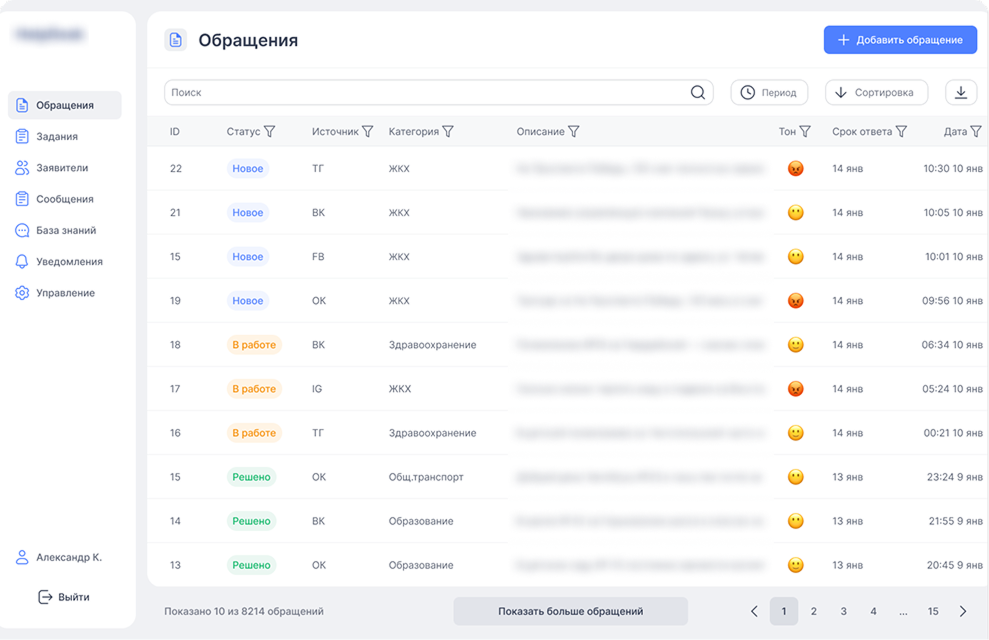
All incoming requests pass through a single entry point, where they undergo initial processing and classification. At this stage, the system determines the topic and automatically routes the request to the appropriate domain:
- urban infrastructure (roads, maintenance)
- housing and коммунальные services (housing & utilities)
- emergency incidents
- other categories
Once routed, the request is assigned to the responsible department and processed through an end-to-end workflow: intake → assignment → resolution → response.
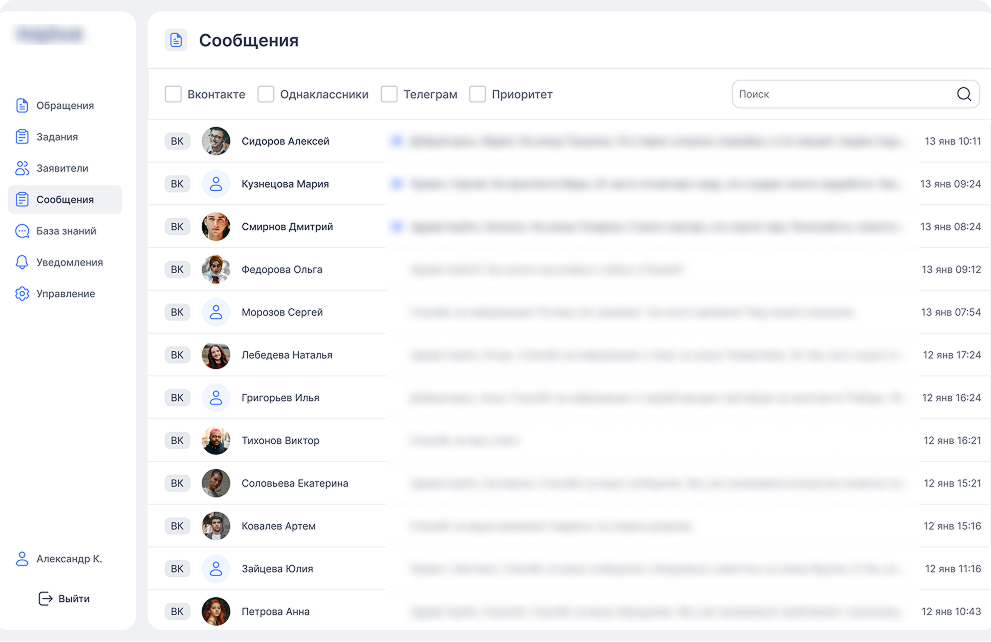
A transparent status model is maintained at every stage, showing exactly where the request stands and what actions are being taken. This eliminates lost tickets and reduces uncertainty for all stakeholders.
Where AI Adds Value
Sentiment Analysis for Request Understanding
The first layer is sentiment analysis.
Each incoming message is automatically analyzed to determine both emotional and operational context:
- neutral request
- negative or conflict-driven message
- potentially urgent situation
This allows operators to instantly assess the nature of the request, while enabling the system to prioritize processing accordingly. In practice, it serves as an early signal of urgency and required response mode.
RAG-Based Knowledge Layer for Fast Responses
The second layer is an intelligent knowledge base built on a Retrieval-Augmented Generation (RAG) approach.
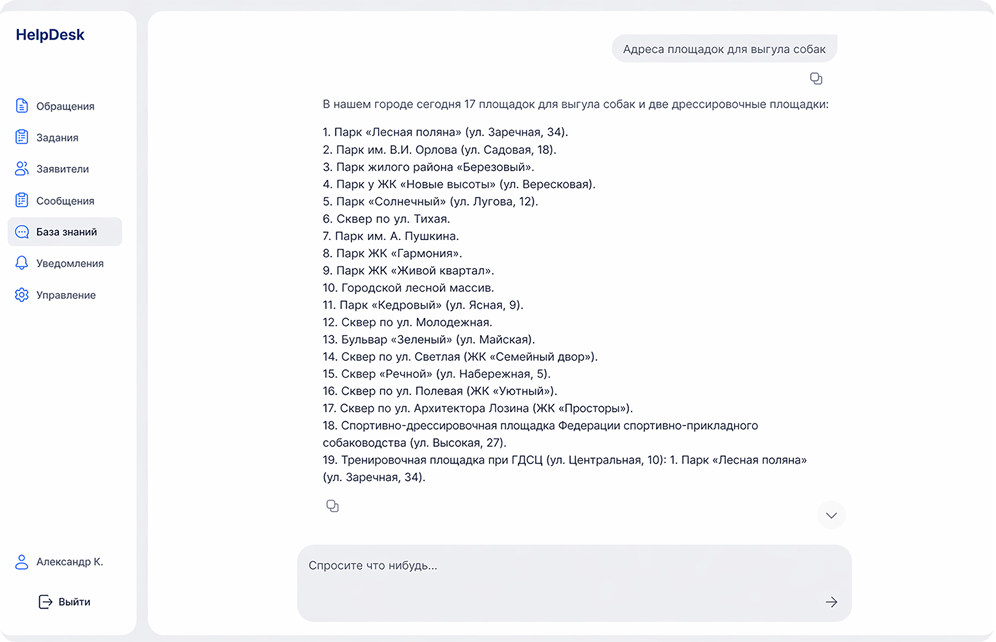
When the system or an operator encounters a standard query, the platform retrieves relevant articles, instructions, or policy-based responses.
This is applied in scenarios where:
- a standardized answer already exists
- no involvement from a specialized department is required
- the request can be resolved quickly without additional routing
In essence, RAG reduces manual information lookup and significantly speeds up handling of repetitive requests.
Outcomes
The platform significantly transformed request processing - from a manual, fragmented workflow to a centralized and predictable system.
Key results:
- 23% of requests are now resolved automatically using standard responses powered by the RAG knowledge base
- Average processing time reduced from 4 hours to 25 minutes due to automated routing and fewer manual operations
- 15% of requests identified as duplicates, enabling automatic merging and reducing workload
Overall, the system not only accelerated request handling but also reduced operational redundancy by eliminating duplicate work and balancing load between automation and human operators.